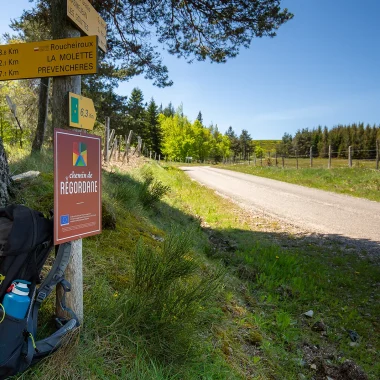
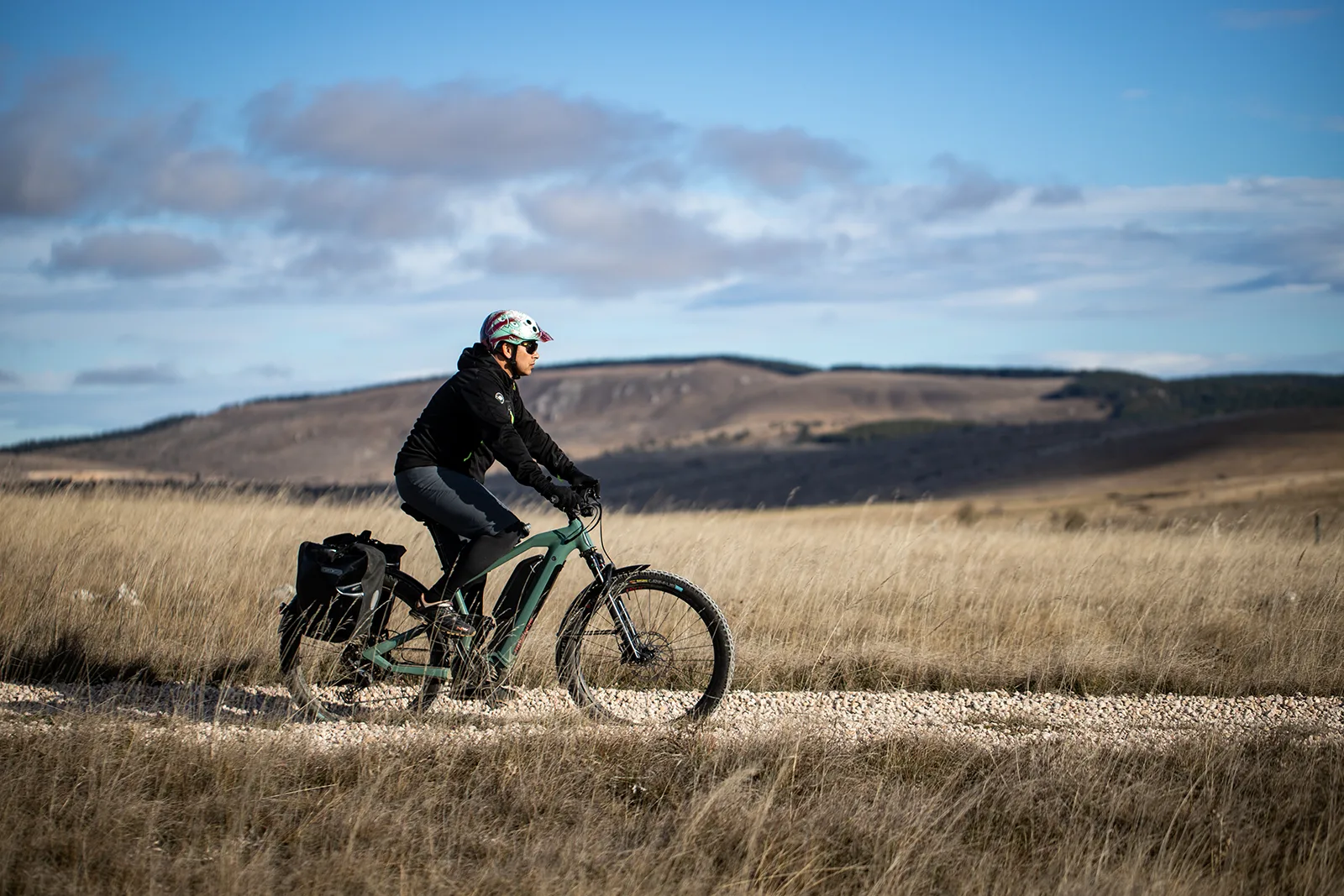
Set off on a bikepacking loop around the Causse Méjean, in the south-west of Lozère, whose wild landscapes and bewildering flatness are reminiscent of Mongolia.
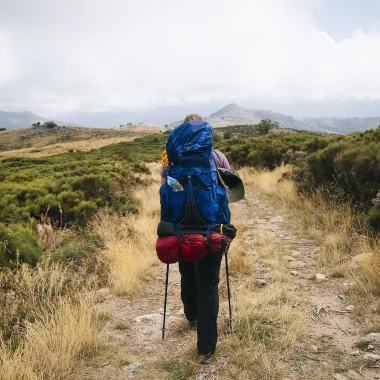
Do you speak bikepacking? Bikepacking is the art and craft of setting off on a cycling adventure, travelling light! With panniers securely attached to your handlebars or bike frame, don’t be fooled into thinking the route will be a walk in the park: the Causse Méjean is a veritable inland island, surrounded by the deep Gorges du Tarn to the north and the vertiginous Gorges de la Jonte to the south. To reach it, you really have to earn it! But what a pleasure it is to pedal your way through these wind-swept highlands, dotted with ‘angel’s hair’… or mineral formations. And what a delight, after a lovely day’s cycling, to relax in the crystal-clear waters of the Tarn!
- 60 €
- average budget
- 50 km
- per day on average
Le Rozier, let’s get started!
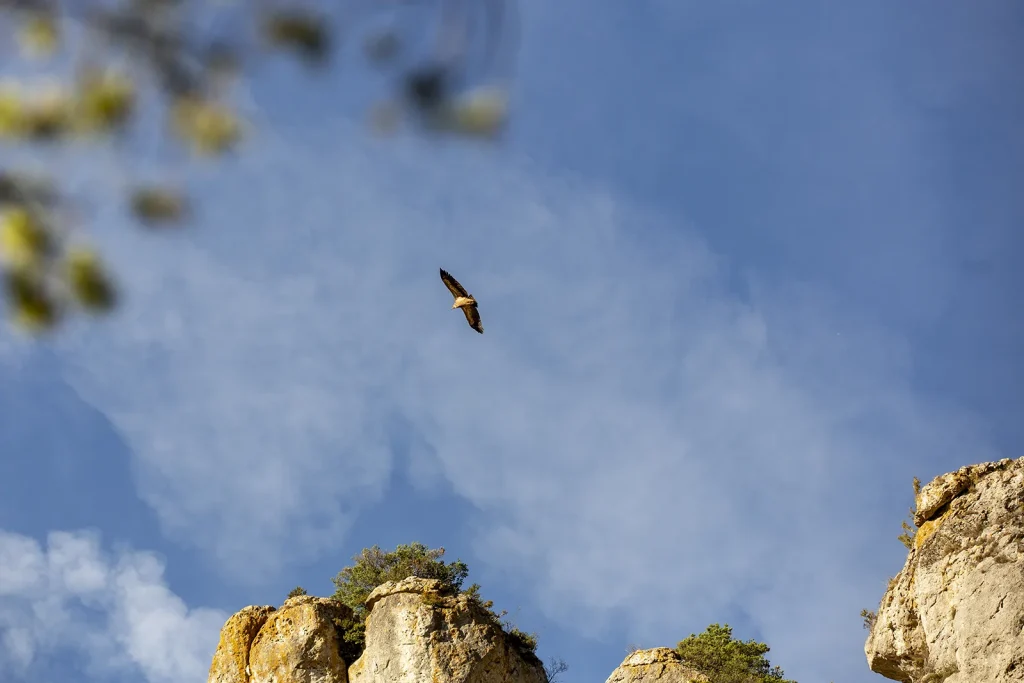
Le Rozier, at the confluence of the Jonte and the Tarn. It feels like the end of the world. Or at least, the end of Lozère. To the west and south lies the Aveyron. And to the east lies adventure! Picking up supplies for the picnic at the Epicerie des 3 Causses, checking the bike and panniers, helmet firmly in place, water bottles filled at the village fountain. This time, we’re off for real. The first few pedal strokes take me along the D996. With the last houses of Le Rozier behind me, all that remains are the Gorges de la Jonte. And the vultures. There are plenty of vultures. It’s worth noting that they were reintroduced to the Gorges in the 1980s. And it’s worked rather well. There are now more than 1,500 of them inhabiting the area. And looking down on the cyclists. From very high up!
From the Jonte Gorges to the Causse Méjean
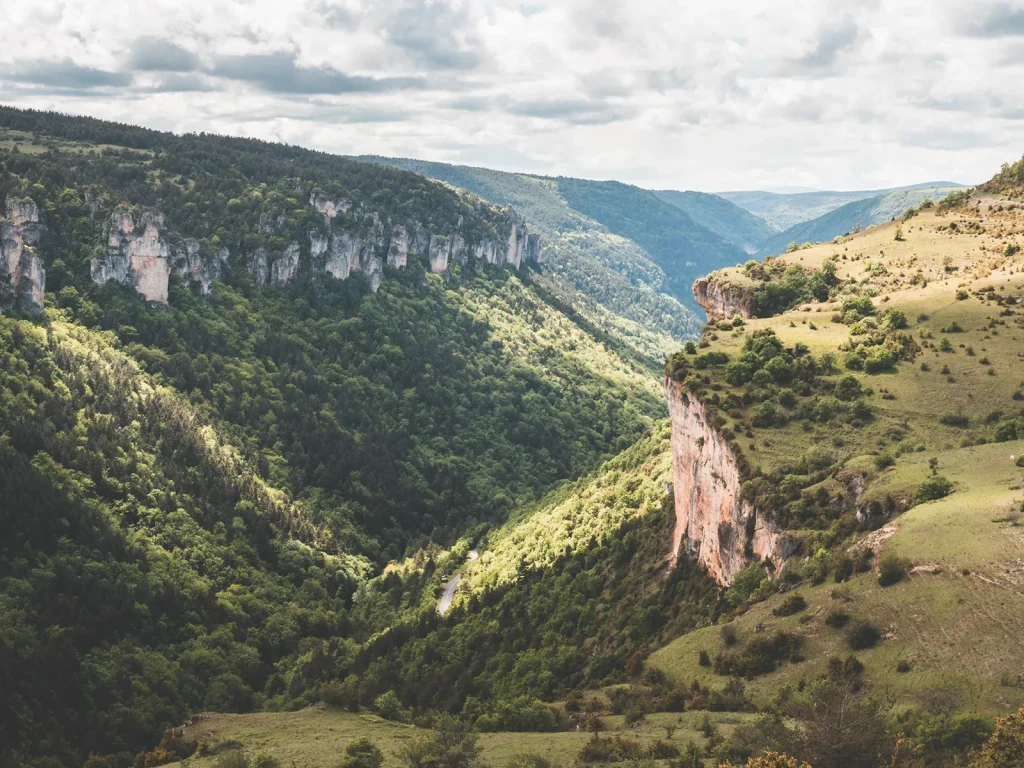
After a 7-kilometre warm-up, it’s time to turn off onto the D63. That’s where the real challenge begins. To reach the Causse Méjean, you’ll need to climb nearly 500 metres. Gulp! Your calves are burning, and the view opens up. The air grows crisper – a real natural breeze: Lozère has thought of everything to win over cyclists! Two lovely hairpin bends and a few more turns of the pedals, and the Causse finally comes into view. It’s hard to imagine that such a flat landscape could follow on from such deep gorges. The Gorges de la Jonte look like a huge gash cut between the Méjean and the Causse Noir. And perched above the abyss: Hyelzas. A population of around fifty. ‘The’ town of the Causse Méjean. And yes, round here there are just 1.4 inhabitants per square kilometre. So a village of 60 inhabitants is a town. A lively and welcoming town, where you can delve into history within the walls of a 17th-century farmhouse, delve into the depths of the Earth to admire the world’s largest stalagmite at the Aven Armand, or treat yourself to a platter of sheep’s-milk cheese whilst looking out over the very sheep that produced it! Yes, a cyclist is a happy man in Hyelzas…
Unusual accommodation
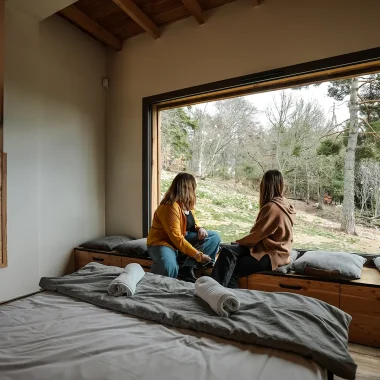
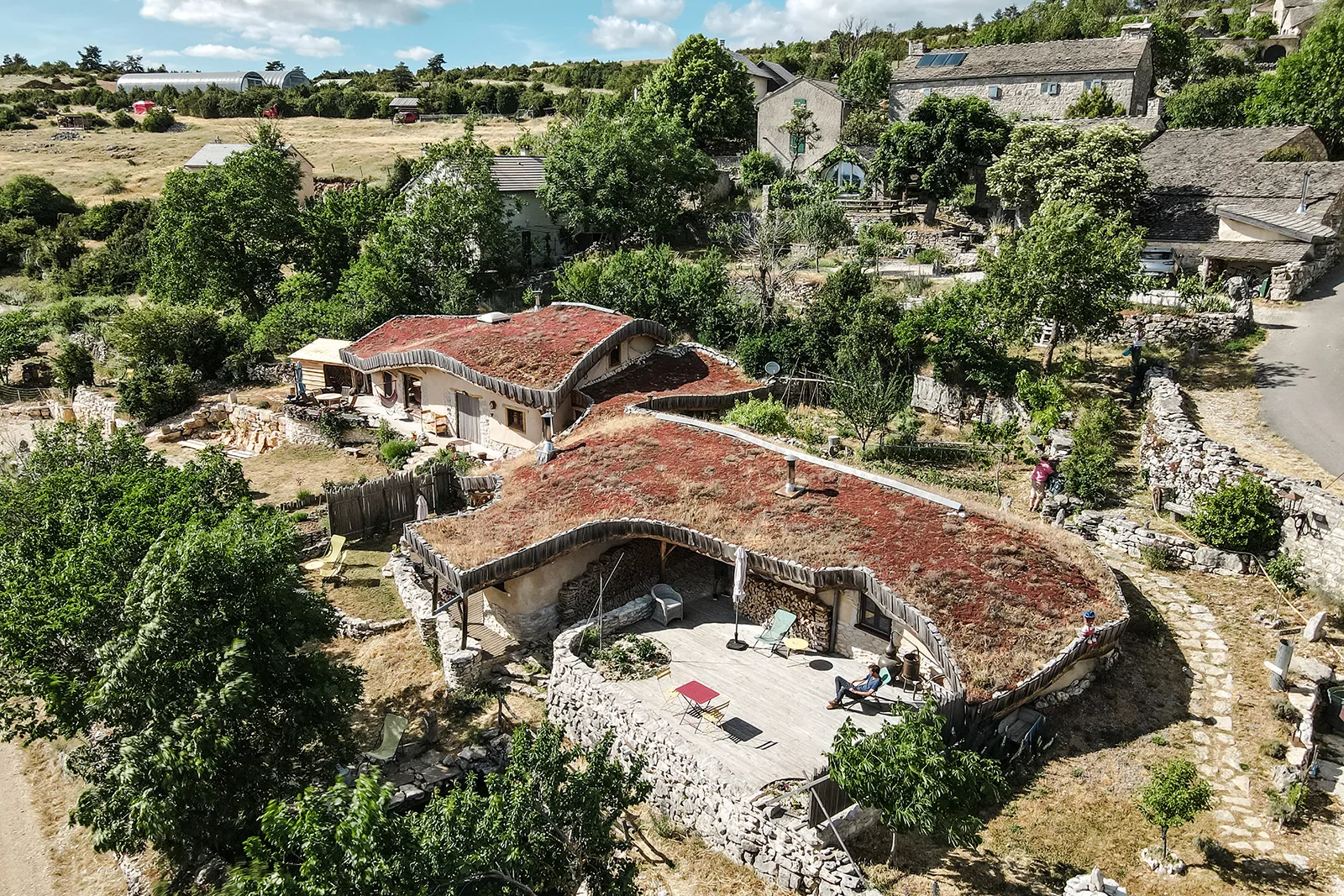
The people of Hyelzas are brimming with ingenuity. Don’t believe it? Why not spend a night at ‘Les Kasalas’ guesthouse – hobbit-style houses half-buried beneath the Causse Méjean – and you’ll change your mind! The icing on the cake? The rooms have been built using eco-friendly methods with local materials such as stone, earth, wood and straw!
Chaos in Nîmes-le-Vieux, straight ahead!
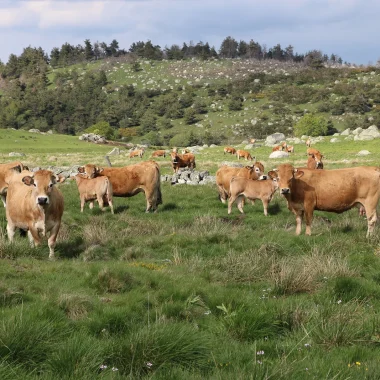
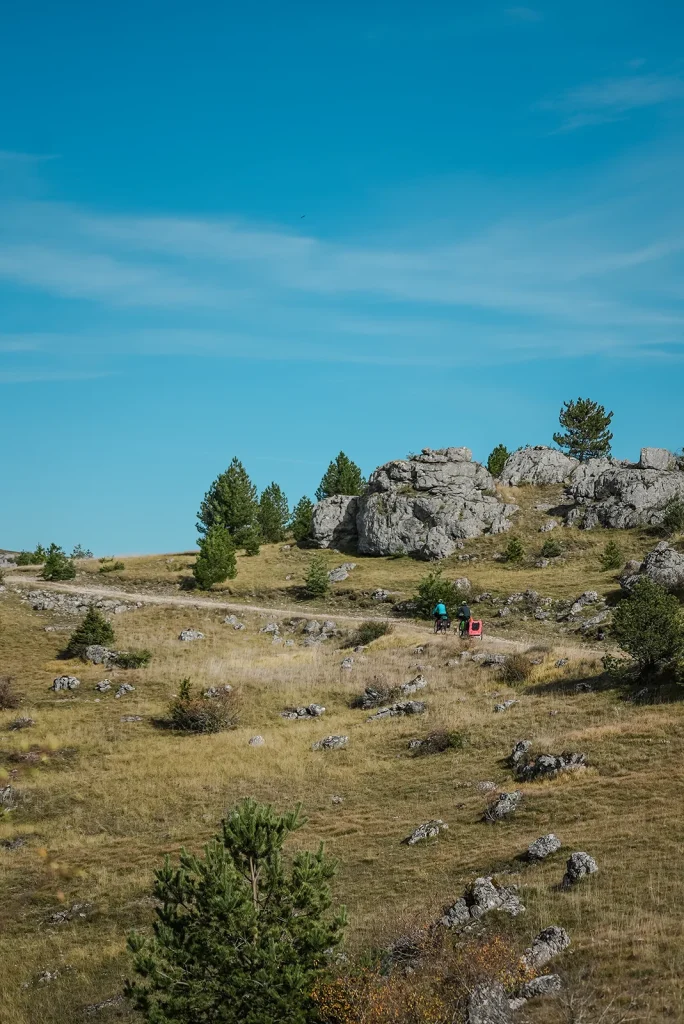
Next stop: the Chaos de Nîmes-le-Vieux, about twenty kilometres east of Hyelzas. With the horizon as your only companion. Well, almost. Because although there aren’t many people in this part of Lozère, they have shaped the landscape over the centuries. UNESCO calls them the ‘cultural landscapes of Mediterranean agropastoralism’. In other words, landscapes kept open thanks to the combined efforts of shepherds and sheep. Landscapes where a nomadic spirit runs in the blood: there are numerous transhumance routes in the area, notably the Chemin de St-Guilhem-le-Désert, which links the Hérault to the lush pastures of the Aubrac in Lozère. So cyclists aren’t the only ones powering towards their destination on the strength of their legs. And what a destination! Nestled between the hamlets of Galy, L’Hom and Le Veygalier, in the heart of the Cévennes National Park, the Chaos de Nîmes-le-Vieux is a real feast for the eyes.
The little pleasures of the Cévennes National Park
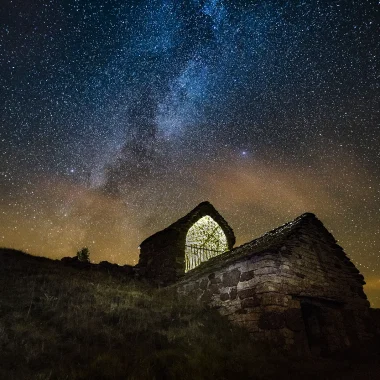
The end of the day is full of contrasts. The schist of the Cévennes gives way to the limestone of the Causse, the roads become winding once more, and the bikes hurtle down the slopes. On the outskirts of Florac, the Tière eco-campsite is the perfect spot for weary bikepackers! Here, there are no mobile homes or swimming pools: the tent comes straight out of the panniers, and it’s in the Tarnon that your muscles can relax. And if sleep is slow to come, there’s no need to switch on the telly: the stars are there to liven up the evening! It’s best not to stay up too late, though, as the morning will be… a real workout!
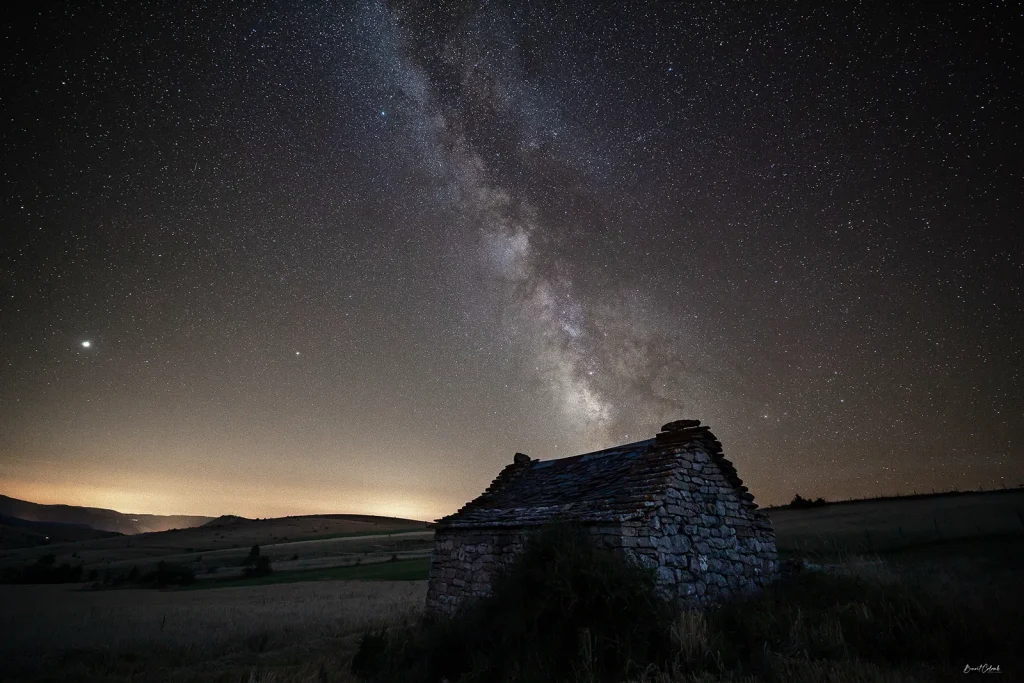

Przewalski’s Horses
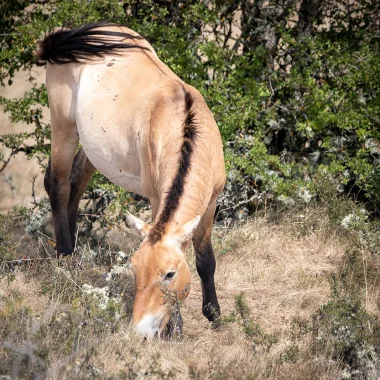
After a smooth ride through Florac, where farmers’ market stalls line the streets every Thursday morning, you’ll need to head up the Méjean. With its hairpin bends, the D16 promises 7 kilometres of steady climbing, all the way to the Col de la Pierre Plate. Don’t worry, this will be the only strenuous part of the day. Once at the pass, with Florac at your feet, all that remains is to take in the vast expanse of the Méjean. And, as you head towards the hamlet of Villaret, try to spot the last wild horses on our planet, straight from Mongolia: the Przewalski’s horses! Keep your eyes peeled… and if your stomach starts to rumble, do pop into the Auberge du Chanet, just next door. A Cévennes-style raclette is just the thing to perk you up!
Fancy going camping in the great outdoors? What a brilliant idea! But please note that, to protect the biodiversity of the Cévennes National Park, certain rules apply. Wild camping is only permitted between 7 pm and 9 am, along long-distance hiking trails. And it is strictly prohibited in certain areas, such as the Chaos de Nîmes-le-Vieux.
From the Causse Méjean to the Gorges du Tarn
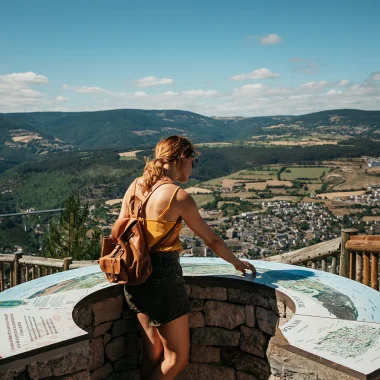
After lunch, we’re heading north at full speed! At the Col de Coperlac, the descent towards the Gorges du Tarn begins along the D986. The first panoramic view is just ahead on the left, and it’s a real treat: an unobstructed view of the Saint-Chély-du-Tarn cirque – you wouldn’t want to miss that! For the rest of the route, you don’t even need to pedal: the bike covers the kilometres to the village of Sainte-Enimie all by itself. You just need to make sure you brake now and then… It would be a shame to end up headfirst in the Tarn!
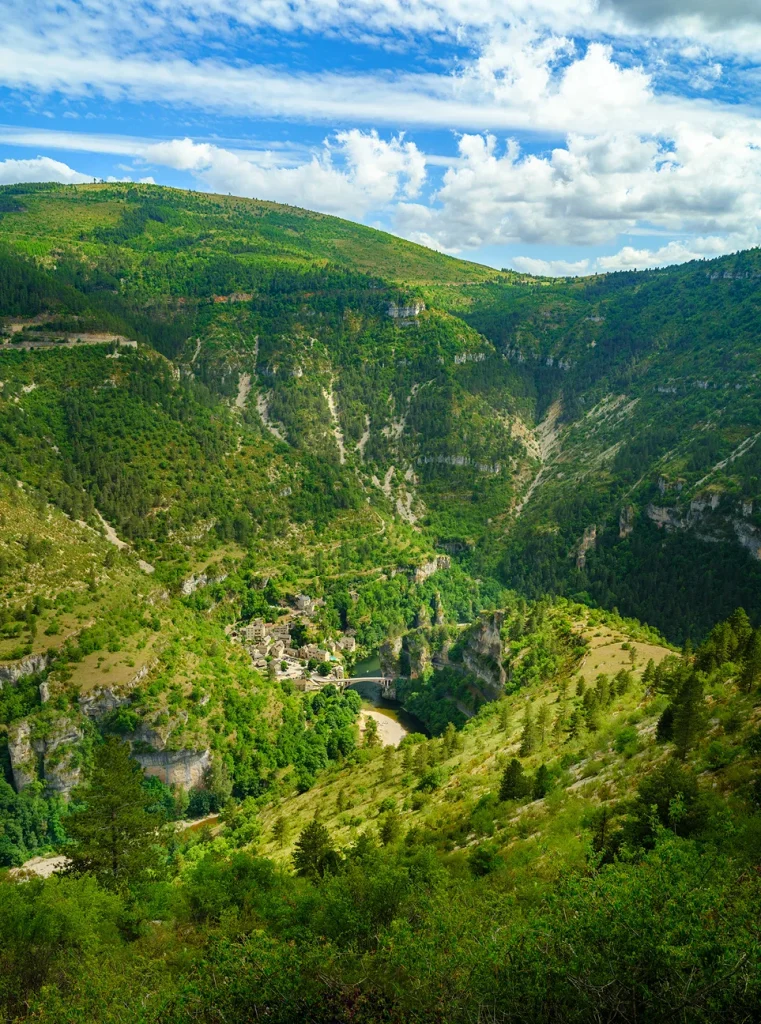
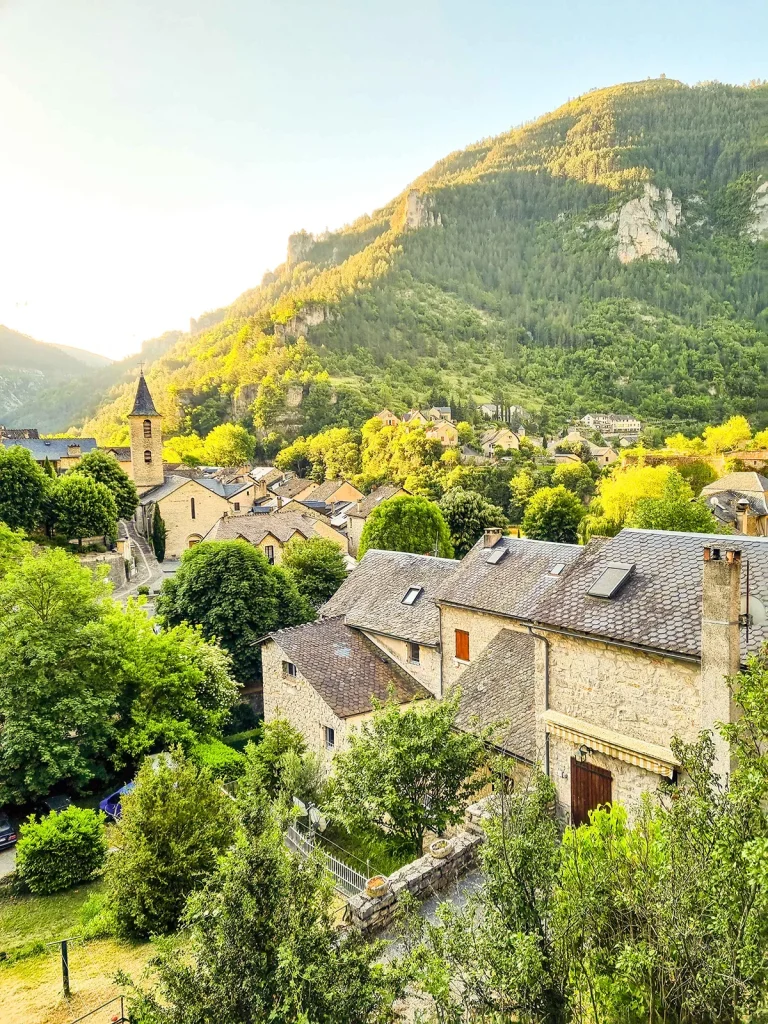
Towards Sainte-Enimie
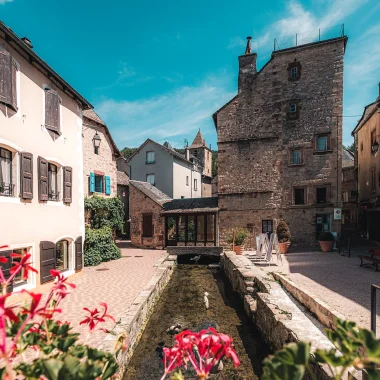
On the other hand, we can’t recommend a dip in the river highly enough. Say hello to the kayakers for us, and lose yourself in the maze of cobbled streets in Sainte-Enimie: it’s one of the ‘most beautiful villages in France’, and you’ll soon see why! Then treat yourself to dinner on a terrace, before drifting off to sleep, safe and sound in your canvas tent, on the banks of the Tarn. And if you hear any noise during the night, don’t worry – it’s probably Father Beaver hard at work…
The winding paths of La Malène
Tent packed away, breakfast wolfed down, shoes on. It’s time to get back in the saddle. Heading west, following the D907 bis. ‘The’ Gorges du Tarn road, opened at the start of the 20th century. Before that, people travelled by boat. You’ll no doubt come across the boatmen when you arrive in La Malène. But before that, let yourself be charmed by the waterfall and the suspension bridge at Saint-Chély-du-Tarn, just as beautiful from below as from above (and 100% Instagram-worthy!). Then on to the monumental Château de la Caze, and the hamlet of Hauterives, which, incidentally, is only accessible by canoe or on foot! The Causse Méjean, however, is indeed accessible by car from the banks of the Tarn. Or by bike. But just this once, it’s worth the effort. Ten hairpin bends take you up the Méjean from La Malène. That’s a 400-metre climb over just 5 short kilometres. Yes, it’s a bit of a slog. But a winding road like this is rather photogenic. And reaching the plateau makes it all the more rewarding. Take it from a cyclist.
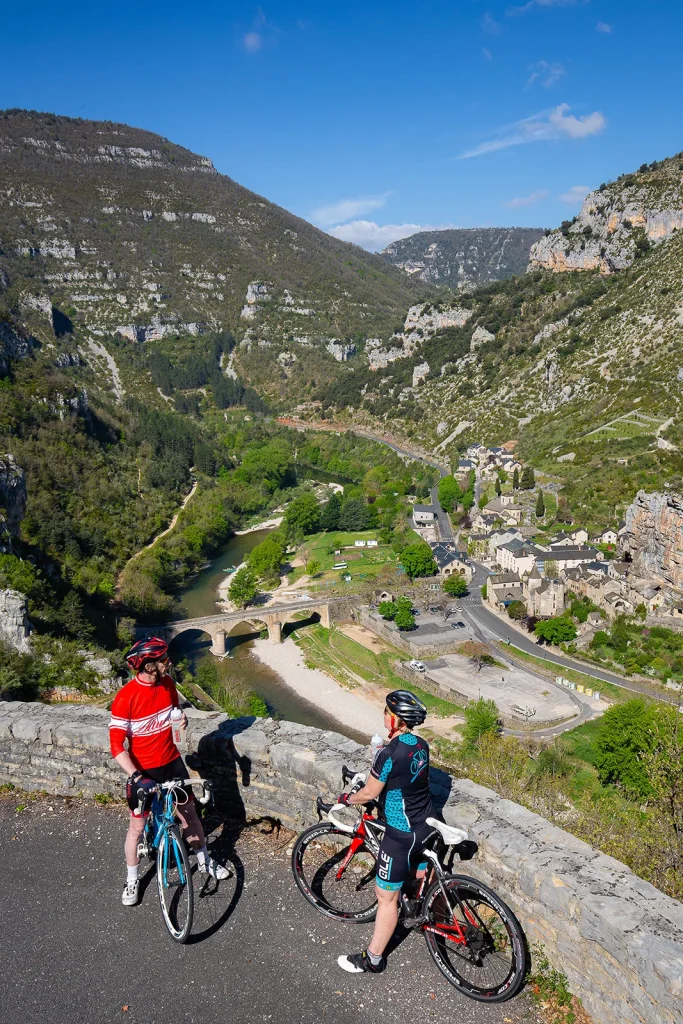
Final moments on the Méjean
Can you feel it, that breeze rustling in your ears? It whispers that you’re almost there, and invites you to savour your last moments of freedom. Your final moments in Méjean. As you head south past the hamlet of Rieisse, you’ll venture inland and approach the heart of Méjean one last time.
With Saint-Pierre-des-Tripiers in your sights. A Causse village, in both body and spirit. A village built of limestone, from its foundations to its rooftops. Limestone. Just like that of the Arcs de Saint-Pierre, those immense rock arches that line up to the west of the hamlet of La Viale. You’ll have to get off your bike to admire them, but I promise you won’t regret this (short) detour on foot! Along the way, you might even come across some caves and the remains of a Gallo-Roman village!
Back in the saddle, the final few kilometres will be a piece of cake. To get back to Le Rozier, all you’ll need to do is let yourself go! Soon, you’ll catch sight of the foothills of the Gorges de la Jonte, the gateway out of the Méjean. But believe us, no matter how hard you slam the door shut, the air of the Causse will continue to lull you to sleep for a looooong time!
Plan your stay
Where to eat, where to stay, what to do?
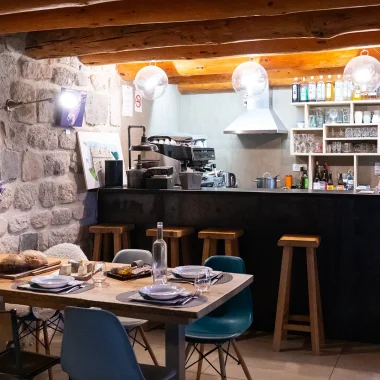
Has this story made you peckish? We understand: cycling really works up an appetite. Follow our recommendations to satisfy your hunger (it would be a shame to disturb the peace and quiet of the Méjean!). We’ve also got a few top tips on where to stay, in case you’d rather go for a ‘bike-without-packing’ sort of trip. Just cycling, basically!
Restaurant

Bar-restaurant


Restaurant


Wild-life park


Boat trips

How do I get there?
- By car: from Montpellier, allow 1 hour 50 minutes’ drive via the A75. To reach Le Rozier, you’ll need to leave the motorway at junction 44.1.
- By tourist shuttle: during July and August, shuttles run between Le Rozier and Millau (a 35-minute journey), Meyrueis (25 minutes) and Florac (1 hour 30 minutes).
- And why not just cycle there?