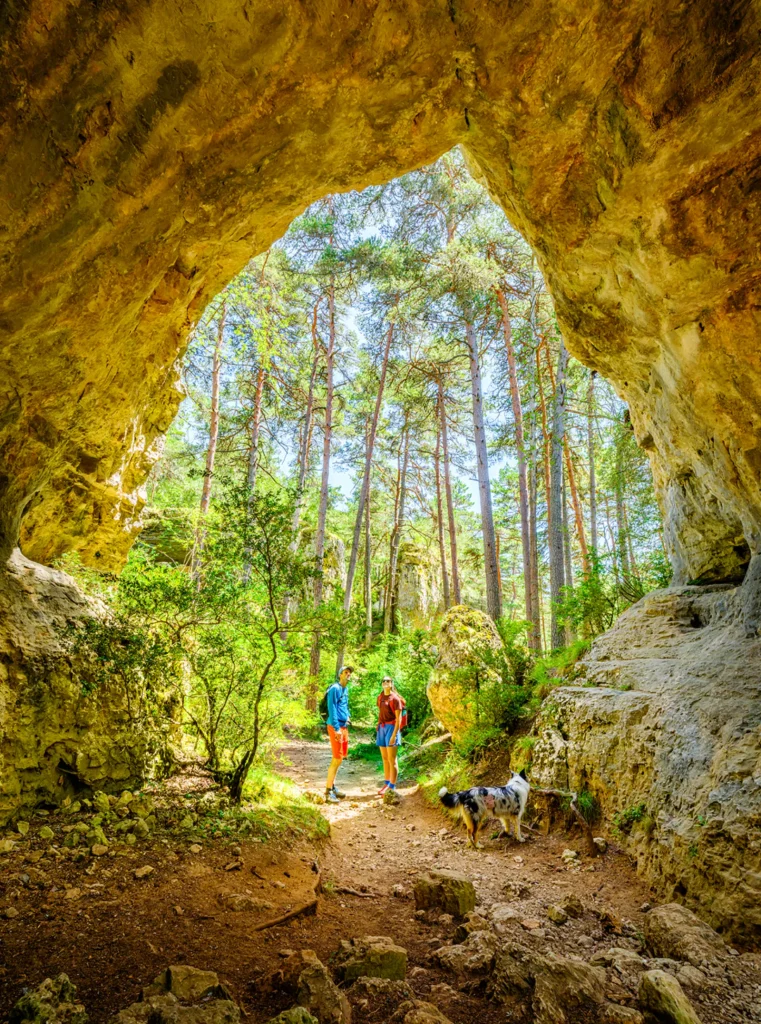
The Arcs de Saint-Pierre site is a rugged, chaotic landscape of natural arches, prehistoric caves and dolomite rocks.
The Arches of Saint-Pierre
A walk to discover them
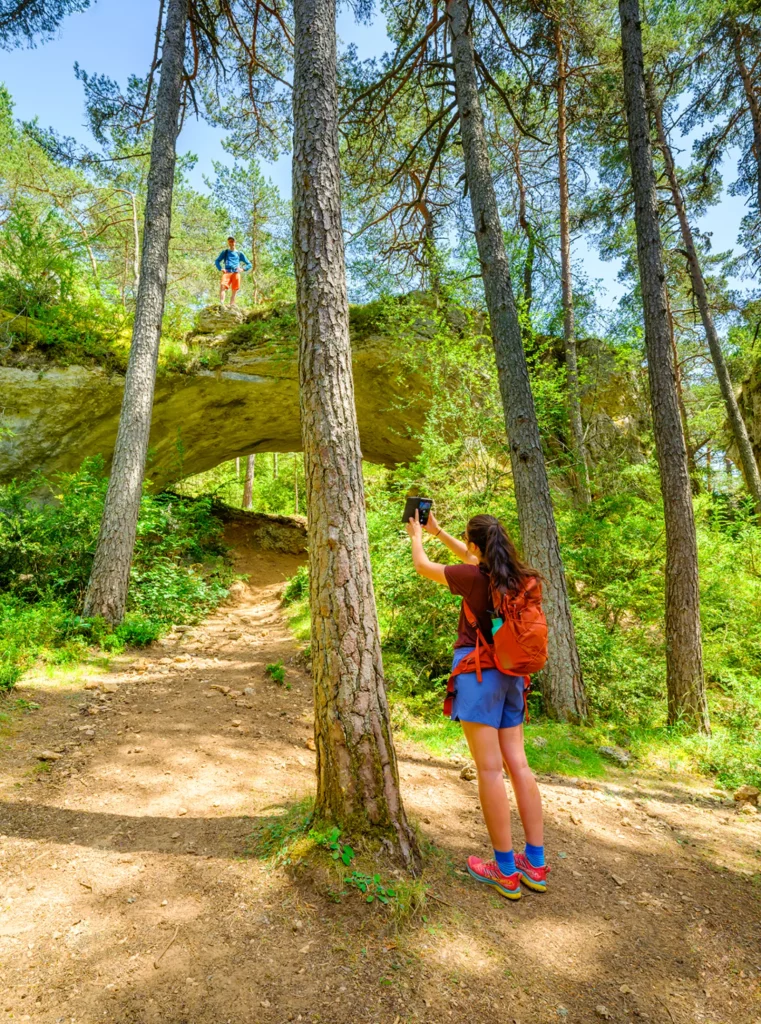
The Causse Méjean is certainly home to some true natural treasures. In the commune of Saint-Pierre-des-Tripiers, the Arcs de Saint-Pierre can also be explored on a walk lasting around an hour and a half. Three stone arches of varying sizes and shapes stand in succession within a pine forest. These arches are mysterious, as they were carved out in an area without a river. One theory put forward is that they may be the traces left by the ebb and flow of the ocean when it covered the region several million years before the arrival of humans. They were discovered in 1929 by the village priest, Abbé Solanet, a man passionate about his region and the author, as early as 1894, of the book “Les Gorges du Tarn illustrées“.
The site boasts a rich variety of flora due to the presence of dolomitic sands within a mosaic of dry grasslands, cliffs and dolomitic rocks. This dolomitic substrate enables the growth of specific and key species. The grey long-eared bat, a remarkable southern bat species, is commonly found at the Les Arcs site in both open and semi-open habitats as well as in the karst environment.
Just a stone’s throw away, a cirque and its monolith, the Baumelles and L’Homme Mort caves, the so-called ‘prehistoric’ village… A journey deep into the past.

Thematics